Pattern 01 · An app that adapts · Interaction pattern
On-demand suggestions per field
Practice view. What to build, the words on screen and how to measure it. Switch to Research for why it should work, the framework properties and the references.Research view. The research side is shown below the card: why it should work, the properties it targets and the references. Switch to Practice to hide it.
Fields stay empty until the user asks for options. The AI proposes three, the user picks one and edits.
The user stays in chargeThe right amount of trustCase: VAIA FormFlow
Done right, done wrong
Schematic screens, not real products. Click a screen to enlarge it.The receipt
A receipt is the result of one test, printed on the card: the case, what was compared, how many people took part, the main result, the methods, and what we do not know. The plan written before the analysis is the study card. How a pattern earns its label.
In practice
Fields stay empty until the user asks. When they do, the system proposes three options with a one-line reason each. The user picks one and edits it, or ignores all three and writes. In the VAIA pilot, this kept people in an authoring stance: participants described per-field suggestions as choosing a direction, and a pre-filled form as checking for errors.
Words on screen
Obligations to keep in mind (AI Act, GDPR)
- Say that suggestions are generated by AI and can be wrong. (O1, IUI 2026, Table 1)
- If the input contains personal data, ask consent before sending it to the model. (O3, IUI 2026, Table 1)
- Keep authorship with the user: options, never a filled-in default, for judgement content. (O4, IUI 2026, Table 1)
Design considerations, not legal advice or a conformity assessment. What O1 to O5 mean.
Build it
Illustrative signatures, not a published library: the names below are suggestions to adapt to your stack. Thresholds are examples to tune on your own data.
States: no input, loading, options, chosen, edited, failed
Component: <FieldSuggest fields={fields} threshold={0.6} onAccept={fn} onEdit={fn} />
Prompt snippet: Return three distinct options for the field, each under 220 characters, plus a one-line rationale. Never fill the field yourself.
Output schema: { "options": [{ "text": "string", "rationale": "string" }] }
Measure it
Same idea, other names
Applied by: VAIA, live in the FormFlow course registration · Replicated by: nobody yet · Used this pattern? Tell us and get listed
Research side · why it should work · framework v0.2
Why it should work
Properties targeted
Notes
Why it should work: the pattern asks for one extra click per field in exchange for authorship. The pilot’s behavioural signal (alternatives viewed, non-top selections) is consistent with the mechanism, but n is six and the domain is one; treat the effect as a hypothesis for other domains.
How to measure: controllability with three items plus override count; trust with trust-scale items plus the ratio of appropriate reliance; efficiency as time from analysis to submit. Report per user group and per case difficulty.
Relations
- Controllability belongs to the user-experience component; the 2025 review found it measured in only 4 of 82 studies, and its map of relations between properties shows none for controllability (Donoso-Guzmán et al. 2025, sections 4.11 and 4.12.6).
- More alternatives may raise cognitive load; the limit of three options is a design choice that has not been measured.
Across contexts
| Context | Users | State | Result |
|---|---|---|---|
| VAIA course forms | course providers | Tested (pilot) | 4 of 6 preferred; 11 vs 6.5 alternatives viewed |
| CNEXT email triage | accountants | Planned, not built yet | |
| FORCIT challenge brief | innovation managers | Seen in a case | |
| Your context | Bring your case |
References
- Amershi et al. 2019, Guidelines for Human-AI Interaction, CHI.
- Van den Bossche and Abdul Khalil 2026, From Pattern Libraries to Practice, IUI Companion. DOI 10.1145/3742414.3794714.
- Donoso-Guzmán et al. 2025, A Systematic Review of User-Centred Evaluation of Explainable AI in Healthcare.
- Parasuraman, R. and Manzey, D. H. (2010). Complacency and bias in human use of automation: an attentional integration. Human Factors, 52(3), 381-410.
Editors
Related patterns
All patterns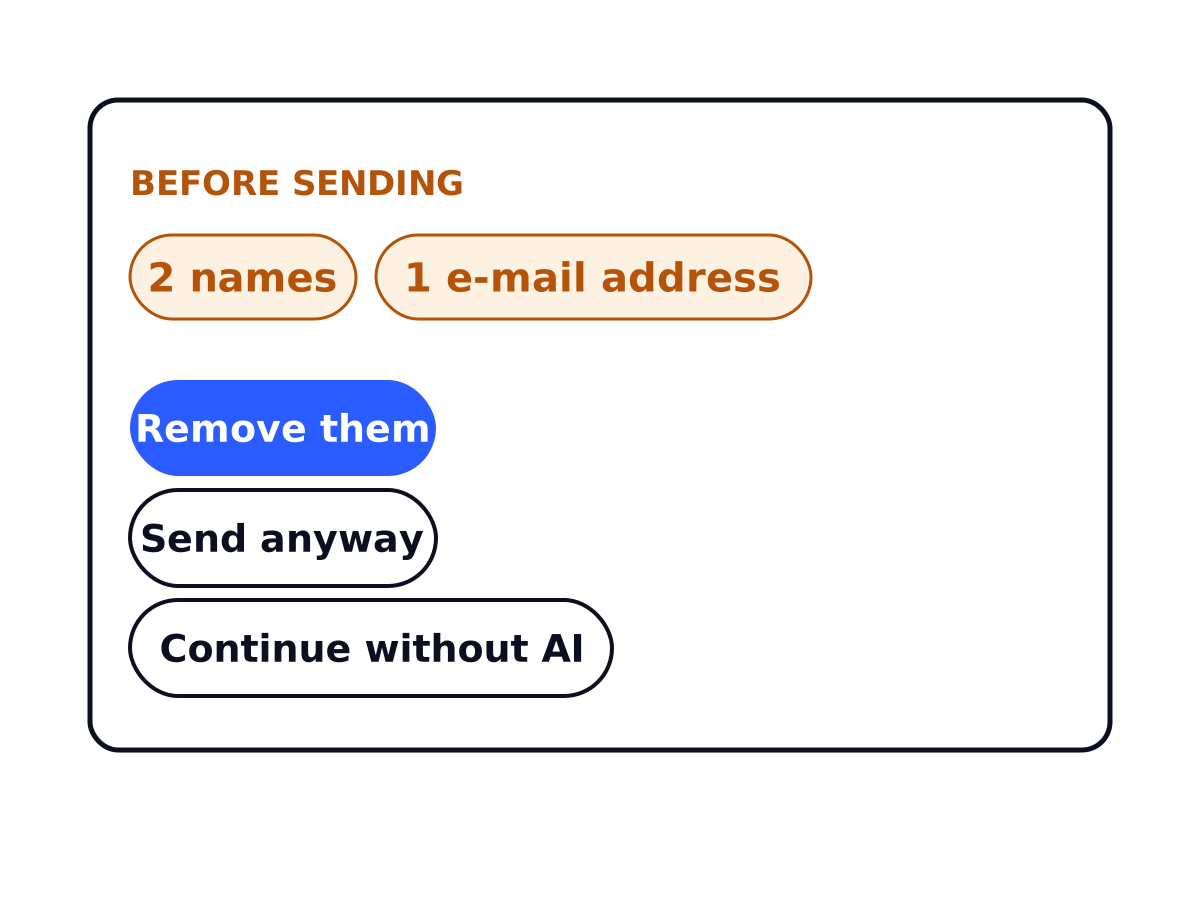 Pattern 03 · An app that adapts, Chat or assistantPrivacy check before sending personal dataBefore text goes to a model, the app spots personal data and lets the user send, strip or skip the AI step.Seen in a case
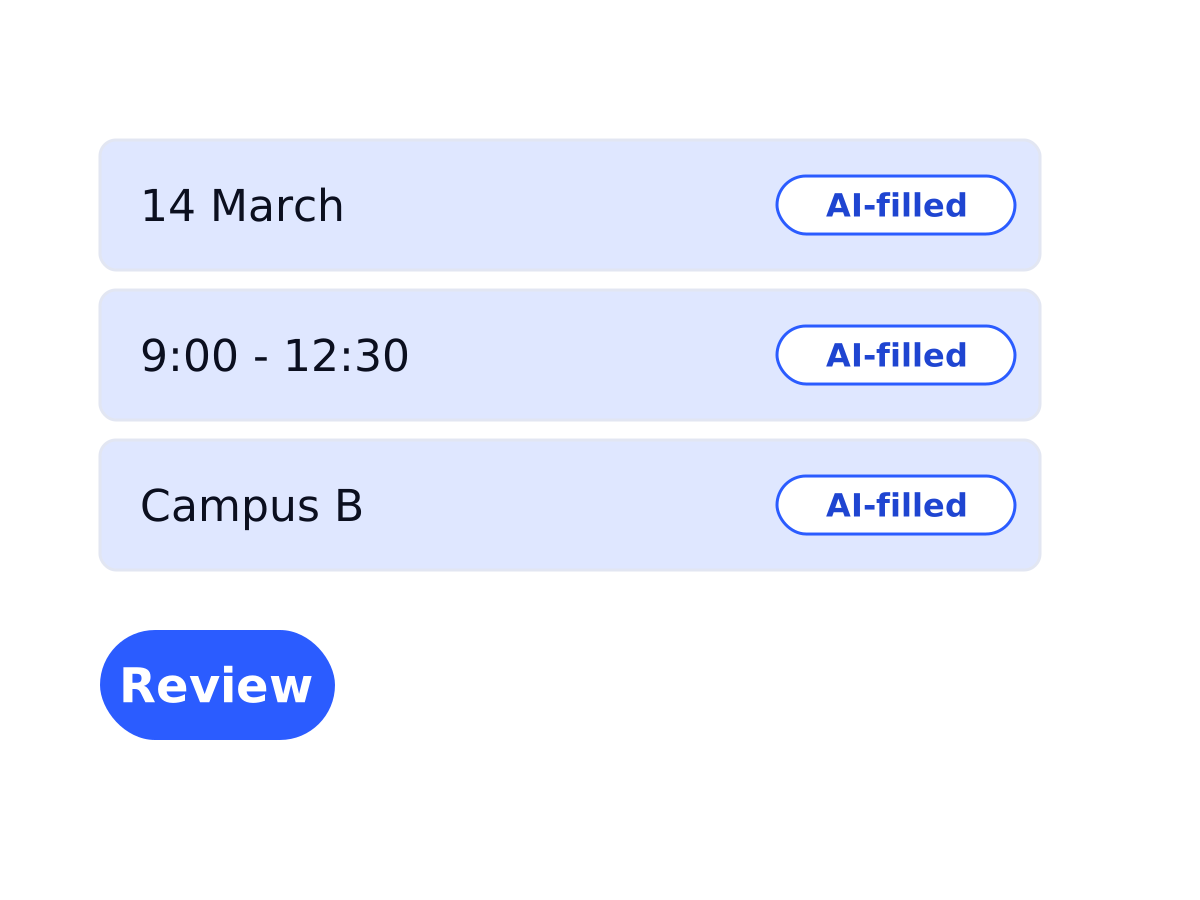 Pattern 02 · An app that adaptsPre-filled form with reviewThe AI fills every field first and the user checks. Suited to facts the system can verify, risky for judgement content.Tested (pilot) · 6 participants
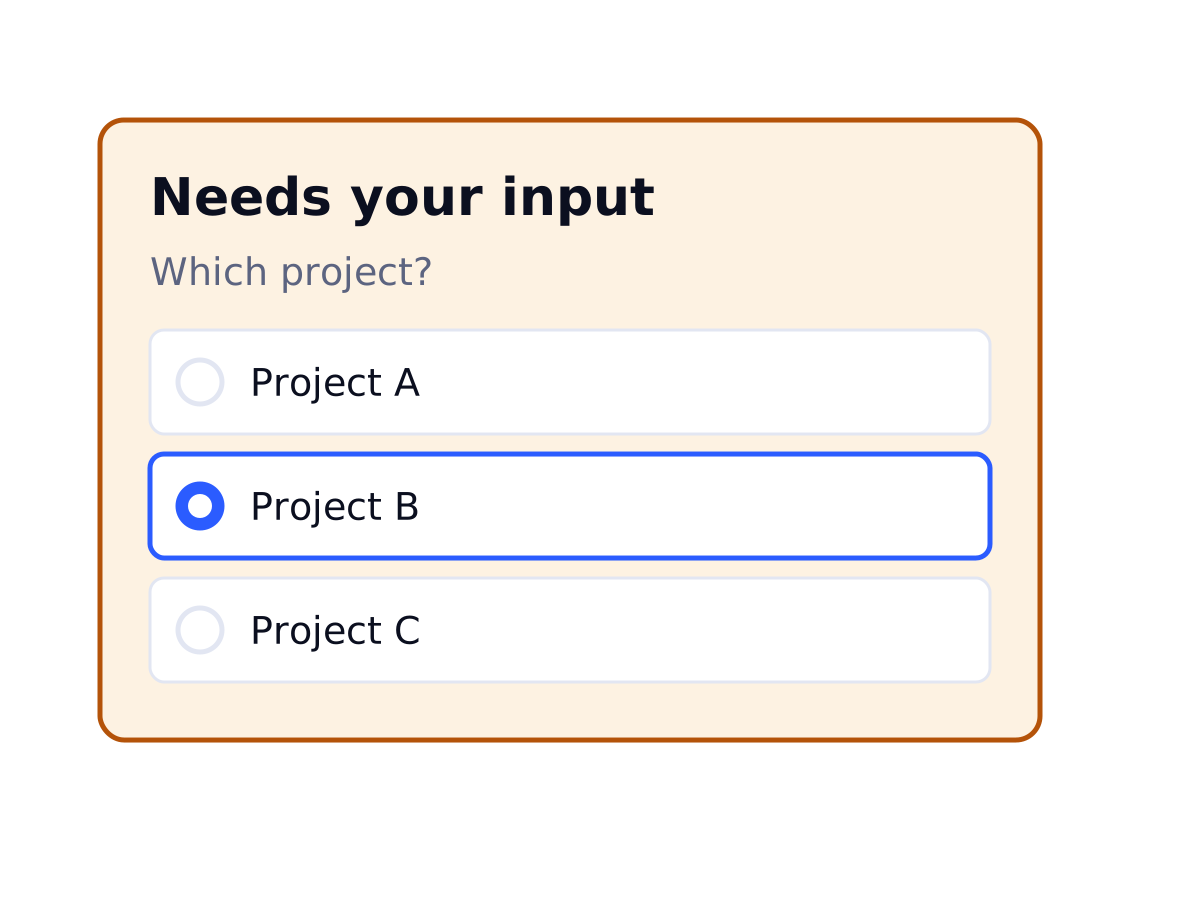 Pattern 06 · Chat or assistant, Dashboard with AI insightsLow-confidence hand-off to a personBelow a threshold the AI stops, says what it could not determine, and hands the item to a person instead of guessing.Seen in a case