Pattern 11 · Chat or assistant · Interaction pattern
Staged conversation: the code decides
Practice view. What to build, the words on screen and how to measure it. Switch to Research for why it should work, the framework properties and the references.Research view. The research side is shown below the card: why it should work, the properties it targets and the references. Switch to Practice to hide it.
The assistant works through a few named phases, for example gather the situation, reflect, practise, close. Each phase has its own narrow instruction and answer format. The model reports a signal such as 'the user seems ready'; ordinary application code decides whether to stay, move on, refuse or try the turn again.
The right amount of trustThe user stays in chargeThe system shows how it worksCase: Goose conversation guide
Done right, done wrong
Schematic screens, not real products. Click a screen to enlarge it.The receipt
A receipt is the result of one test, printed on the card: the case, what was compared, how many people took part, the main result, the methods, and what we do not know. The plan written before the analysis is the study card. How a pattern earns its label.
In practice
Goose version 3 was a free-form chat. Participants liked its answers, but it often asked several questions in one turn, its tone felt too formal and its purpose was not clear at the start. Version 4 wrapped the model in a deterministic shell: a small set of phases, one instruction and one answer format per phase, and a controller that reads the model’s structured fields and decides. Three SUPR-Q dimensions went up and the recommend score barely moved, with three and four answers per round. One participant said the predictable structure gave her more trust than an open AI tool.
Two honest notes for anyone copying this. First, the price: less flexibility for the user and more design work up front, exactly the work a free chatbot seems to make unnecessary. Second, the shell only counts when the code really decides. A code audit of Goose found that in most turns the controller simply adopted the route the model proposed. Write a test that sends the same conversation twice and expects the same phase changes; if that test cannot exist, the pattern is not yet in place.
Words on screen
Obligations to keep in mind (AI Act, GDPR)
- Phase changes and refusals are decided by code, so they can be tested, logged and explained; keep them out of the prompt. (O2, Goose v4)
- Tell people the assistant follows a fixed path, so the structure reads as a feature and not as stubbornness. (O1, IUI 2026, Table 1)
Design considerations, not legal advice or a conformity assessment. What O1 to O5 mean.
Build it
Illustrative signatures, not a published library: the names below are suggestions to adapt to your stack. Thresholds are examples to tune on your own data.
States: gather, reflect, practise, close, refused
Component: <StagedChat phases={schema} onSignal={fn} />
Prompt snippet: You are in phase 'reflect'. Ask one question about feelings. Return { reply, ready_for_next, out_of_scope }. You do not choose the next phase.
Output schema: { "reply": "string", "ready_for_next": false, "out_of_scope": false }
Measure it
Same idea, other names
Applied by: nobody yet · Replicated by: nobody yet · Used this pattern? Tell us and get listed
Research side · why it should work · framework v0.2
Why it should work
Properties targeted
Notes
Why it should work: the person can form a mental model of the assistant because its behaviour is bounded per phase, and the boundaries do not move from turn to turn. Credibility rose from 3.75 to 4.38 between the free-form and the staged version of Goose, but with different participants, several simultaneous changes and three and four SUPR-Q answers per round; treat that as a direction, not an effect size.
How to measure: compare a staged and a free-form version of the same assistant, with the same participants and the same tasks. Take phase violations as the primary behavioural metric: repeated steps, role changes, and answers given in a refused state. Add SUPR-Q credibility and the trust items from the vocabulary. Report per participant, because small samples hide reversals.
Relations
- Controllability relates to trust: the possibility of interaction increases trust in the system (Donoso-Guzmán et al. 2023, Table 2).
- One question per turn (pattern 12) lowers cognitive load inside each phase; the two patterns are usually implemented together.
Across contexts
| Context | Users | State | Result |
|---|---|---|---|
| Goose conversation guide, v4 | adults preparing a difficult conversation | Seen in a case | credibility 4.38 versus 3.75 for the free-form v3; three and four SUPR-Q answers per round |
| Your context | Bring your case |
References
- De Wilde, R. (2026). Goose project summary, Odisee UX Lab (internal).
- Donoso-Guzmán et al. 2025, A Systematic Review of User-Centred Evaluation of Explainable AI in Healthcare.
- Donoso-Guzmán, Ooge, Parra and Verbert 2023, Towards a comprehensive human-centred evaluation framework for explainable AI. arXiv 2308.06274
- Amershi et al. 2019, Guidelines for Human-AI Interaction, CHI.
Editors
Related patterns
All patterns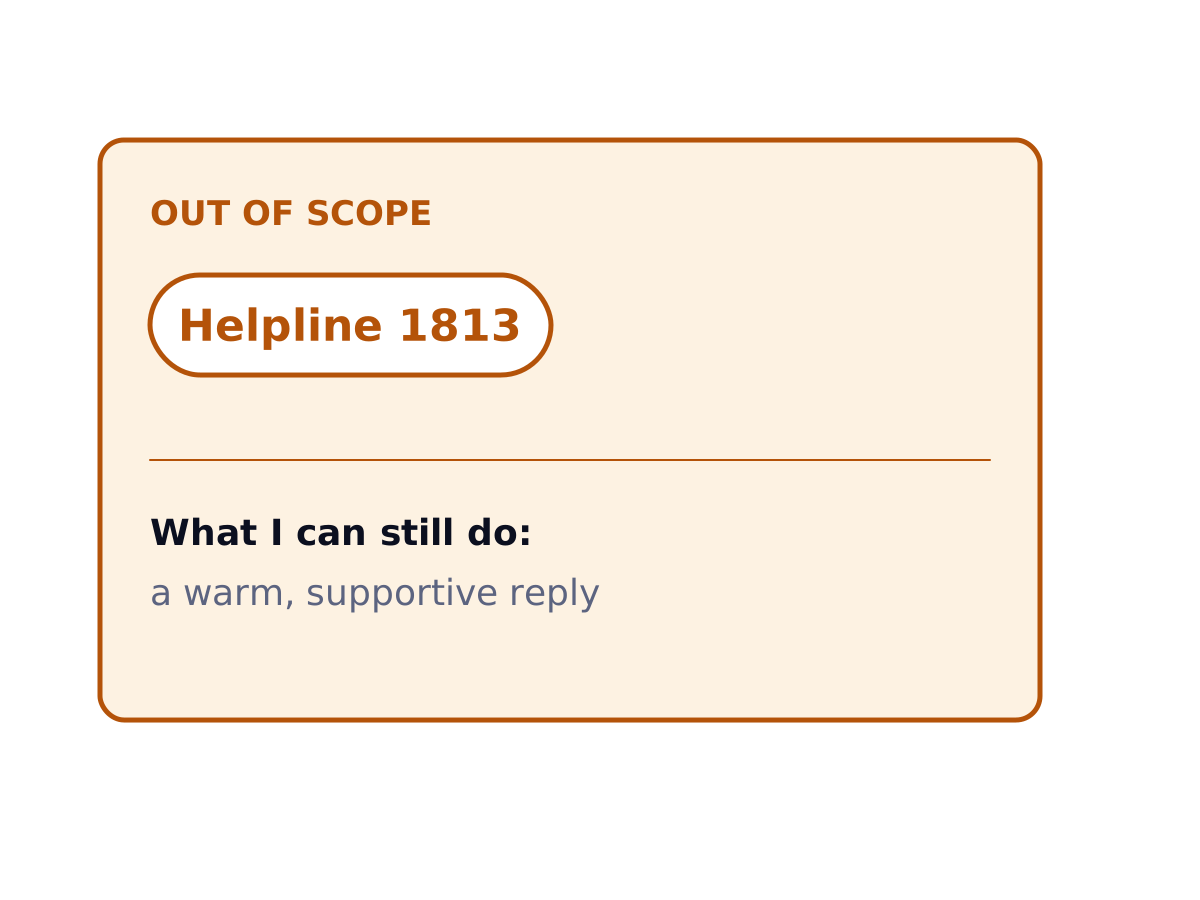 Pattern 13 · Chat or assistantOut-of-scope refusal with a next stepWhen a request leaves the assistant's remit it says so, offers a safe next step and, where lives may be at stake, a helpline. Decided by code, not by mood.Seen in a case
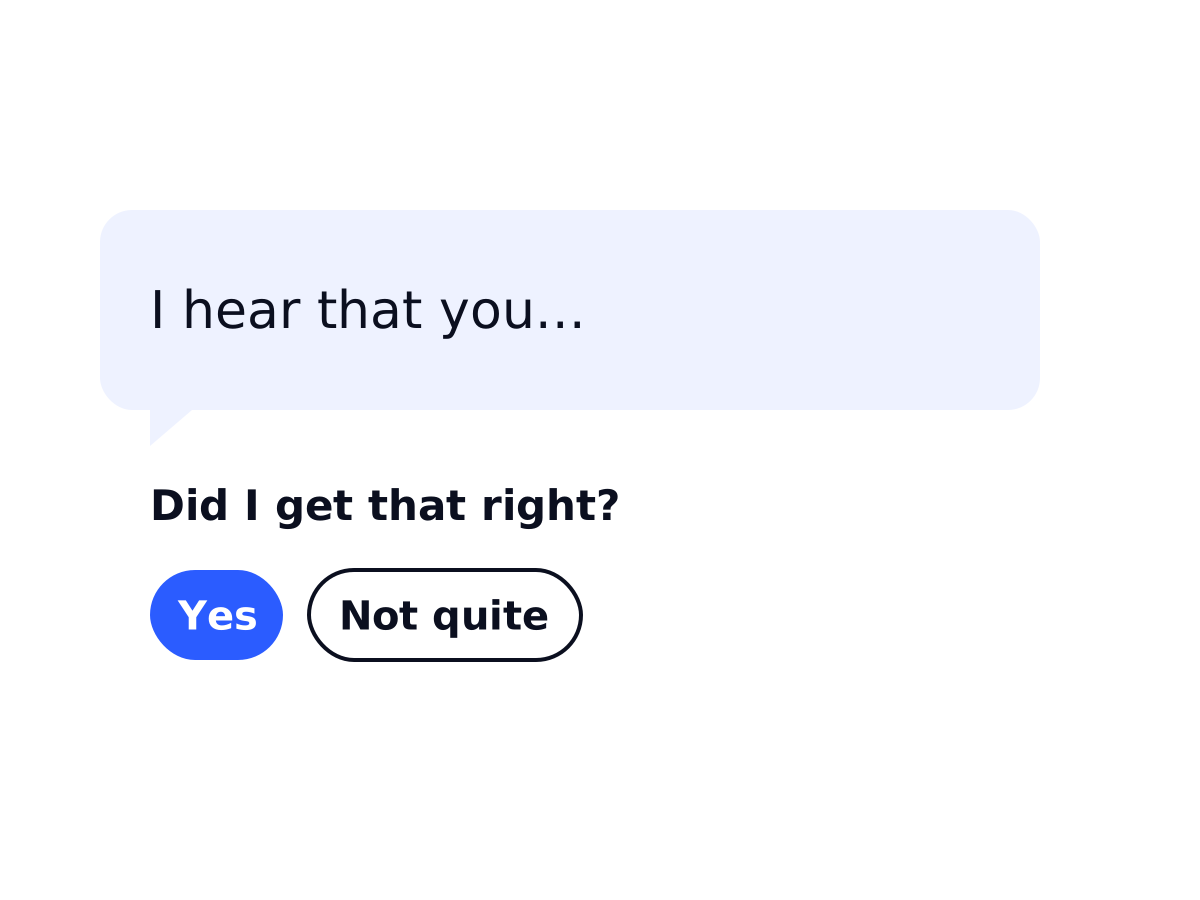 Pattern 14 · Chat or assistantParaphrase before you adviseThe assistant first mirrors what the person said in its own words, then asks or suggests. Only what was said, never what it guessed.Seen in a case
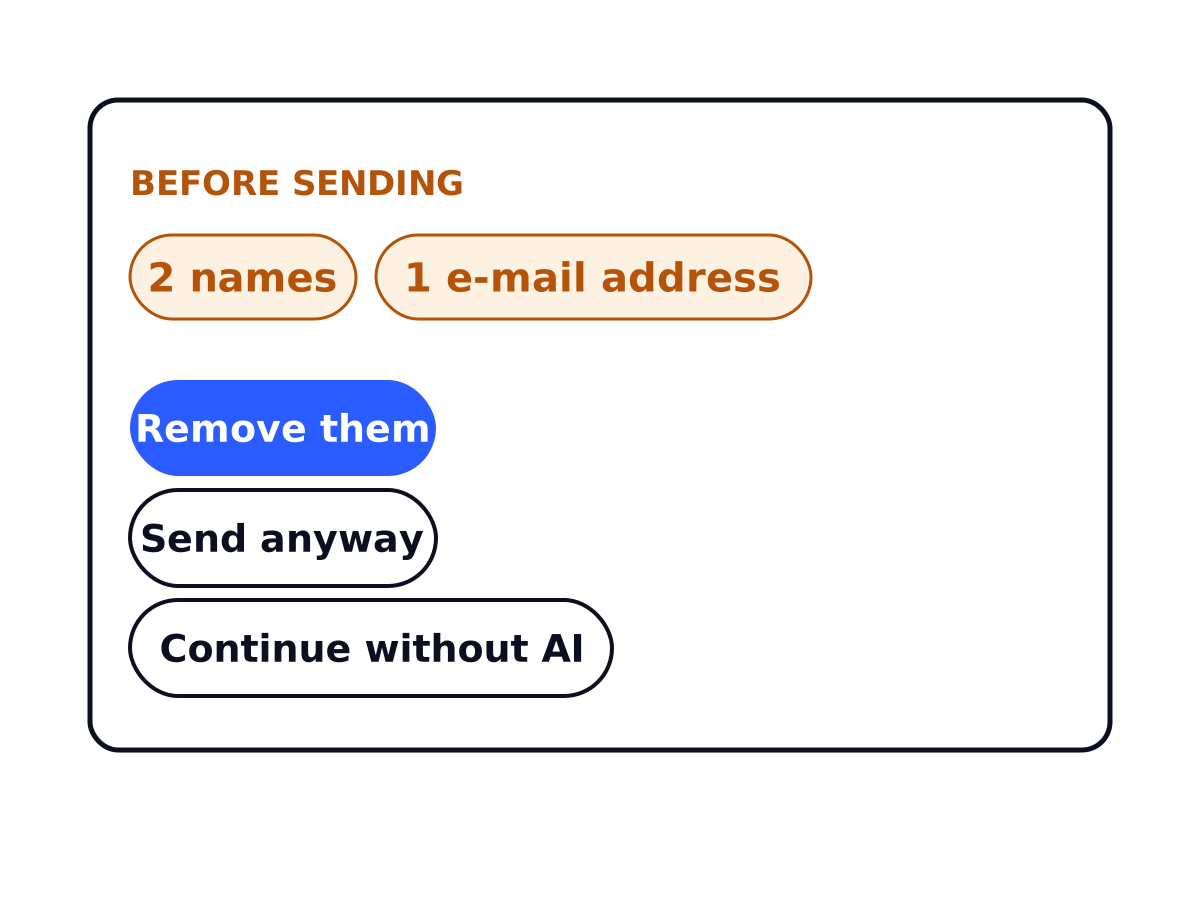 Pattern 03 · An app that adapts, Chat or assistantPrivacy check before sending personal dataBefore text goes to a model, the app spots personal data and lets the user send, strip or skip the AI step.Seen in a case